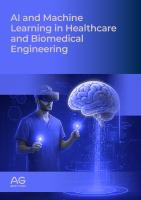
Al and Machine Learning in Healthcare and Biomedical Engineering
Keywords:
Artificial intelligence, Machine learning, Medical imaging, Brain tumors, Lung cancer, Biomedical engineering, Medical Internet of Things (IoT), Implantable medical devices viiiSynopsis
AI and Machine Learning in Healthcare and Biomedical Engineering presents a collection of recent research at the intersection of artificial intelligence, medical imaging, and biomedical hardware design. The volume focuses on two tightly coupled domains: AI-driven analysis of oncological imaging (with an emphasis on brain and lung tumors) and machine-learning-assisted optimization of low-noise front-ends for medical Internet of Things (IoT) devices and implantable systems. On the imaging side, several chapters propose advanced pipelines for preprocessing and enhancing MRI and CT data, including filtering, contrast enhancement, and transform-based techniques, as well as multimodal MRI–PET fusion. These methods aim to improve image quality and tumor boundary visibility, facilitating more reliable segmentation and diagnosis. Building on these foundations, the book explores deep and hybrid learning models—convolutional neural networks combined with classical classifiers—as well as feature extraction and selection strategies that integrate textural, frequency-based, and deep representations. Experiments on benchmark datasets for brain and lung tumors show that these approaches can achieve high accuracy and robust performance, underscoring the diagnostic potential of AI-based methods. At the hardware level, the book examines how machine learning can guide the design of low-noise amplifiers for medical IoT and implantable communication in medically allocated frequency bands. The chapters demonstrate that data-driven optimization can reduce noise figures, improve gain-versus-power trade-offs, and accelerate convergence in multi-objective design spaces, yielding LNAs with performance suitable for low-power wearable and implantable devices. By bringing together methods for image enhancement, multimodal fusion, feature engineering, classification, and hardware optimization, this edited volume offers an integrated view of how AI and machine learning can be embedded throughout the sensing, processing, and communication chain in modern healthcare systems. It is intended for researchers, graduate students, and practitioners in biomedical engineering, medical imaging, electronics, and health informatics who seek both methodological insight and application-oriented case studies.
Chapters
-
Chapter 1. Classification of Lung Nodules on CT Images by Employing Machine and Deep Learning Techniques
-
Chapter 2. Machine Learning-Assisted Optimization of Low Noise Amplifiers for Medical IoT Applications
-
Chapter 3. A Current-Reuse Narrowband LNA for Medical Implant Communication Service (MICS) Applications
-
Chapter 4. Multimodal Fusion Techniques for Integrated Biomedical Imaging
-
Chapter 5. Unsupervised Learning-Based Classification of Breast Cancer Using Gaussian Mixture Model
-
Chapter 6. Role of Neoadjuvant Radiotherapy in the Management of Rectal Cancer
-
Chapter 7. Implementation of an Anaerobic Digestion with Co-Digestion and Nutrient Recovery for Sustainable Waste Management and Urea Fertilizer Production in an Institute
Downloads
Published
December 15, 2025
Copyright (c) 2025 Vugar Abdullayev (Volume editor); V Rajesh, B Rakesh Babu, Hussein Alkattan, Salam Abdulkhaleq Noaman, Abrar Ryadh, Mostafa Abotaleb, H.K. Al-Mahdawi, Elman Azimov, Pushan Kumar Dutta, Sahib Huseynov, Aygun Ibrahimova, Abuzarova Vusala, Mahbuba Shirinova (Chapter Author); Alex Khang (Volume editor); Jarupula Somlal, N Narender Reddy, Sk Hasane Ahammad, Ebrahim E. Elsayed, Davron Juraev, Nazila Ragimova, Vugar Abdullayev, Saggurthi Spandana, Mohammed R. Hayal, Bahar Asgarova, Elmina Gadirova (Chapter Author)

Details about the available publication format: PDF
PDF
ISBN-13 (15)
978-9915-704-01-2.pdf
How to Cite
1.
Abdullayev V, Khang A, editors. Al and Machine Learning in Healthcare and Biomedical Engineering [Internet]. AG Editor; 2025 [cited 2025 Dec. 30]. Available from: https://books.southam.pub/index.php/books/catalog/book/978-9915-704-01-2.pdf