Latin American Memories, Conflicts, and Futurities: Identity, justice, and social change (Spanish Version)
Keywords:
memory, identity, social justice, Latin America, transformationSynopsis
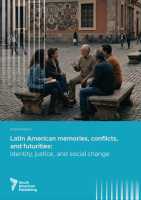
This book explores the ways in which memory, conflict, identity, and justice shape everyday life and social debates in Latin America. Across its chapters, it brings together diverse voices and perspectives to reflect on processes of peacebuilding, collective memory, political participation, socio-environmental conflicts, digital change, cultural practices, and the evolving forms of democracy in the region. The contributions draw on different disciplinary traditions—including history, anthropology, communication studies, political science, literature, and public policy—to examine how people and communities understand their pasts, navigate power relations, and respond to persistent inequalities and emerging challenges. Rather than offering a single narrative, the book invites readers to engage with multiple experiences and interpretations that reveal the complexity of Latin American societies today. By connecting historical memory with present struggles and future possibilities, the book offers a thoughtful and accessible reflection on social transformation in Latin America, aimed at scholars, students, and readers interested in the region’s ongoing debates.
Chapters
-
Chapter 1. Exceptions to the principle of prohibition of the threat or use of force in international relations: contemporary issues
-
Chapter 2. From the jungle to the underground: a comparative reading of extraheccionism in Colombia and the Democratic Republic of Congo in the 21st century
-
Chapter 3. An analysis of Brazil’s foreign policy: from Bolsonaro to Lula as seen from the autonomy of the periphery
-
Chapter 4. The popular election of members of the Judiciary in Mexico: democratic deepening or institutional regression? A comparative and normative analysis from a Latin American perspective
-
Chapter 5. Social outburst (2019-2020), the demand for the political
-
Chapter 6. Imaginaries of peasant speech in the novel of the revolution: literary microhistory as a proposal
-
Chapter 7. The Meeting at La Mejorana: Its Enigmas and Lessons
-
Chapter 8. The Russian constitution of 1993: Vladimir Putin. consolidation of a new political system
-
Chapter 9. The socialist mayoralty of Joseíto Ruíz in Yaguajay, Notes on a transparent and popular administration
-
Chapter 10. Education for survival
-
Chapter 11. Kantian categories as a bridge between intuition and understanding
-
Chapter 12. Opinions of baccalaureate students towards academic integrity and dishonesty
-
Chapter 13. STEAM methodology for teaching content and functions
-
Chapter 14. Migration and emotional entrapment: narratives about emotions and life projects on the northern border
-
Chapter 15. Subjects of human (in)security in contexts of violence under neoliberal capitalism. The case of León, Guanajuato
-
Chapter 16. The Cuban Diaspora from interventions in the series Rumbo Norte: Beyond the Blue Wall (1994) by Cuban photographer Willy Castellanos
-
Chapter 17. The municipality of Guanabacoa and José Martí: an indissoluble bond
-
Chapter 18. Martian Republicanism
-
Chapter 19. Livestock fairs in the history of Guáimaro (1939-1958)
-
Chapter 20. Actions for unaccompanied children and adolescents (nnana) in Tijuana, from a social framing perspective
-
Chapter 21. Institutional imaginaries of the Mexican revolution: from the armed outbreak to the presidency of Miguel Alemán Valdés (1910-1952)
-
Chapter 22. Traditional medicine in the Sierra Norte de Puebla, the case of Arroyo Zarco: a historical and cultural approach
-
Chapter 23. Against nobody’s science: feminist precisions for other possible knowledge
-
Chapter 24. Protest on the ballot? The null vote and the judicial election in Mexico
-
Chapter 25. Cultural Narratives on Caregiving: Film and Literature in Latin America
-
Chapter 26. The doi moi: the socialist road to Vietnam
-
Chapter 27. A station that marches with the times
-
Chapter 28. The anus as a violator of lives: anal politics in two mexican masculinities
-
Chapter 29. Masculinities of the peripheries: reflections from fieldwork with men
Downloads
Published
January 10, 2026
Copyright (c) 2026 Erika Alfonso Villar (Volume editor); David Rebolledo Sánchez, Dayana Rosa Reyes Barreiro, Adriana Amores Moreno, Javier A. Amores Moreno, José Antonio Fernández Ayra, Carolina Galindo Herrera, César Humberto Acuña Espinoza, María José Pedraza Espíritu, Nohemí Raquel González García, Said Hernández Quintana, Fermín Esquivel Díaz, Cristian L. Jiménez Sánchez, Luis D. Águila Atria, Idael Valdés Martínez, Roger Ricardo Santiago Luis, Iraida María Calzadilla Rodríguez, Diana Hernández Castillo, Amayrani Alfaro Valle, Yessica Vázquez Salgado (Chapter Author); Yolier Izquierdo Cuellar, Yasmani Pérez Forteza (Volume editor); Camila Concepción Martínez, Laura Elízabeth Martínez Galindo, Wilson Jair Ordoñez Lasso, Carlos Daniel Hernández Orozco, Yolier Izquierdo Cuellar, Emmanuel José Ávila Estrada, José David Ibarra Espinoza, Julio César Arranz Flores, Brenda García Herrera, Alejandro Enrique Darias Camejo, Edwin Cristian García Vivas, Cristian Lorenzo Jiménez Sánchez, Eva Rodríguez Blanco, Camilo Alejandro Maldonado Suarez, Ana Yolanda Lara Reséndiz, César Pompeyo Caldiño Jiménez (Chapter Author)

Details about the available publication format: PDF
PDF
ISBN-13 (15)
978-9915-704-15-9
How to Cite
1.
Alfonso Villar E, Izquierdo Cuellar Y, Pérez Forteza Y, editors. Latin American Memories, Conflicts, and Futurities: Identity, justice, and social change (Spanish Version) [Internet]. South American Publishing; 2026 [cited 2026 Sep. 29]. Available from: https://books.southam.pub/index.php/books/catalog/book/978-9915-704-15-9