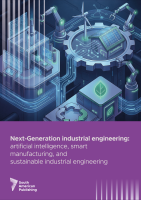
Next-Generation Industrial Engineering: Artificial Intelligence, Smart Manufacturing, and Sustainable Industrial Engineering
Keywords:
Industrial Engineering, Artificial Intelligence, Smart Manufacturing, Sustainable Engineering, Cyber-Physical SystemsSynopsis
Next-generation industrial engineering is increasingly defined by the interaction between artificial intelligence, smart manufacturing systems, and sustainability-oriented design. This book brings together contributions that examine how these elements reshape industrial decision-making, production processes, and engineering responsibility. Across its chapters, the book explores the role of data-driven models, machine learning techniques, and cyber–physical systems in contemporary manufacturing environments. Intelligent scheduling, predictive maintenance, quality monitoring, and digital twins are discussed as practical tools that influence operational choices. At the same time, attention is given to organizational and technical limits, including data quality, system integration, workforce adaptation, and governance challenges. Smart manufacturing is presented as a socio-technical environment rather than a purely automated space. Human expertise, institutional context, and operational judgment remain central, even as algorithmic systems gain prominence. Sustainability considerations further complicate this landscape. Energy consumption, resource management, lifecycle assessment, and environmental accountability shape engineering priorities and constrain design alternatives. Rather than offering universal solutions, the book recognizes that industrial transformation unfolds unevenly across sectors and regions. By combining theoretical reflection with applied examples, it presents industrial engineering as a field navigating complexity, uncertainty, and responsibility. The volume contributes to ongoing discussions about how intelligence, connectivity, and sustainability can be integrated into industrial systems without reducing engineering practice to technical abstraction.
Chapters
-
Chapter 1. Application of Artificial Intelligence in Drip Irrigation Management: Addressing Water Scarcity in Uzbekistan’s Kashkadarya Region Through Wastewater Reuse and Reverse Osmosis Filtration
-
Chapter 2. Cybersecurity, Safety, and Reliability in a Smart Industrial Environment
-
Chapter 3. Digital Twin Technologies for Process Simulation and Control
-
Chapter 4. Emerging Trends in Artificial Intelligence, Robotics, and Quantum Engineering
-
Chapter 5. Generative Artificial Intelligence and Machine Learning for Manufacturing Optimization
-
Chapter 6. Integration of Artificial Intelligence and Robotics in Industrial Engineering
-
Chapter 7. Optimizing Manufacturing Processes Through Data Analytics, Big Data, And Predictive Modeling
-
Chapter 8. Research on the Process of Obtaining Pure Sesame Oil Using Microwave Radiation
Downloads
Published
March 9, 2026
Copyright (c) 2026 Vugar Abdullayev (Volume editor); Farkhod Bazorov, Xaqberdiyev Asliddin, Diyorbek Islomov, Vasila Abbasova, Jale Agazade, Yegane Aliyeva, Khojiakbar Egamberdiev, Bekhruz Suvonov, Shavkat Khayriddinov, Og’abek Toshniyozov, Jasur Farmonov, Mohichehra Sobirova, Erkin Erkinov, Fargan Asadov, Jurayev Otkirbek, Gilder Cieza Altamirano (Chapter Author); Alex Khang (Volume editor); Adilbek Turgunov, Asliddin Xaqberdiyev, Fazliddin Ibodillaev, Xurshid Azimov, Farxod Ochilov, Oybek Asrorov, Avaz Sa'dullayev, Davron Juraev, Vugar Abdullayev, Nazila Ragimova, Bahar Asgarova, Mahbuba Shirinova, Irada Seyidova, Zulfiyya Asadova (Chapter Author)

Details about the available publication format: PDF
PDF
ISBN-13 (15)
978-9915-704-21-0
How to Cite
1.
Abdullayev V, Khang A, editors. Next-Generation Industrial Engineering: Artificial Intelligence, Smart Manufacturing, and Sustainable Industrial Engineering [Internet]. South American Publishing; 2026 [cited 2026 Sep. 16]. Available from: https://books.southam.pub/index.php/books/catalog/book/978-9915-704-21-0